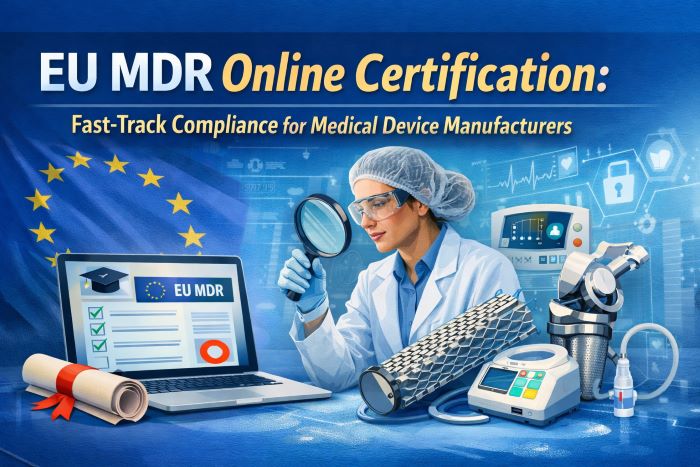
EU MDR Online Certification: Fast-Track Compliance for Medical Device Manufacturers

EU MDR Online Certification: Fast-Track Compliance for Medical Device Manufacturers

Things are really changing for medical devices in Europe. Moving from the old rules to the Medical Device Regulation (MDR) 2017/745 is a big deal. These new rules ask for way better safety and openness. For a lot of companies, getting it all right feels like a never-ending maze. The good news is, new online options can help you get there quicker. An EU MDR Online Certification provides the structured path needed to meet these rigorous legal expectations without slowing down your operations.


Understand the New Regulatory Demand

The European Union has made it tougher for any medical stuff you want to sell there. It’s not just about the final product anymore. Now, they look at every step of the device’s life. Companies have to show more proof from tests and have better paperwork. Plus, there are stricter rules for watching what happens after the product is sold. Figuring all this out takes some serious know-how of the law. If you don’t know what you’re doing, you could get stuck with delays or not be allowed to sell your stuff. That’s where new online programs really help fill in the gaps.


Benefits of Digital Learning Paths

In the medical world, time is money. Going to classes in person can take too long and cost too much. Learning online lets your teams learn when they can. These programs break down those confusing legal papers into simple lessons. They go over important stuff like handling risks and sorting out what kind of device you have. By utilizing an EU MDR Online Certification, your staff can gain specialized knowledge from any location. This means you can keep your projects on track while making sure you’re following all the rules.


Strengthen Your Compliance Team

Getting through this change smoothly is all about your team. Everyone needs to know what they should be doing under the new rules. That means the people doing research; making sure things are good quality, and even the marketing folks. Comprehensive EU MDR Implementation Training is the best way to align your internal teams. When everyone speaks the same rule language, you’ll make fewer mistakes. Good learning helps your team spot any holes in your current papers. Plus, it gets them ready for those tough checks from the Notified Bodies. Spending money on your team now can save you from big mess-ups later.


Simplify Technical Documentation

Those tech papers are super important for following MDR rules. They have to be spot-on and always up-to-date. Now, you need a much better Clinical Evaluation Report for almost every device. A lot of companies have trouble with all the info they need. Online courses give you templates and checklists to make it easier. They show you how to arrange your info the right way. This keeps things tidy and makes it easier for the people checking your work.


Manage Post Market Surveillance

Following the rules doesn’t stop when a product hits the shelves. The MDR really focuses on what happens after the sale. Companies have to keep track of data on how well the device is working. That means making regular safety reports and managing how you handle any problems. Good EU MDR training gives you what you need to set up these systems. Learning how to automatically gather data can save your team tons of time. It makes sure you stay on top of any safety worries and keep your place in the market.


Secure Long Term Market Access

Every company wants to get their stuff to patients safely and quickly. Having a valid certificate is the only way to sell in Europe. It also shows you’re all about quality in other parts of the world. When you go for EU MDR certification online, you’re showing that you care about safety. This helps keep your brand looking good. Plus, it makes sure your business can keep up in a changing world. Online learning is the quickest way to get from today’s problems to tomorrow’s wins.

MDR Consultants Certified Trainer

About The Author:

Isabel Osorio is the president and founder of MDR Consultants Inc. , a medical device consulting firm specializing in regulatory and quality consulting services for the medical device industry. She is a former member of industry following a 16-year career in the medical device field, where she gained extensive experience as an Engineer, a Lead Auditor and a Certified Trainer for Notified Bodies, and as a medical device consultant. While working on the front lines as a Clinical Specialist years ago, a chance encounter opened her eyes to the detrimental effects of companies skipping past proper quality controls and procedures.

This experience changed her perspective on the importance of Medical Device Standards and Regulations forever and inspired her to focus her career on helping medical device companies and professionals better understand the requirements to ensure confidence and competence in their implementation of relevant requirements. Product malfunctions can have harmful effects on someone’s life, including death, and that patient could be you or a loved one. That is why patient safety is at the heart of her MDR Consultant’s mission to provide best-in-class training and consulting services. You can reach her at info@mdrconsultants.com

URGENT: Is Your Medical Device Market Access At Risk?

URGENT: Is Your Medical Device Market Access At Risk?

The EU MDR Deadlines Are Here.

Medical device manufacturers worldwide are facing a looming crisis. The clock is ticking on the EU MDR Implementation Training as crucial transition deadlines fast approach, threatening market access and potentially halting sales for non-compliant devices. Failure to act now could result in costly delays, product recalls, and significant financial penalties.


The Ticking Clock: Deadlines You Cannot Ignore


The time for theoretical guidance is over. The European Union has set concrete, non-negotiable deadlines for compliance. Ignoring these dates puts your entire product line and business at severe risk:


Device Class –

Final Transition Date (May 26, 2026 Regulation extended dates)

Class III custom-made implantable devices –

May 26, 2026

Class III or Class IIb Implants (excluding WET devices) –

December 31, 2027

Other Class IIb, IIa, Is, Im, and Ir (including WET devices) –

December 31, 2028


Furthermore, the full functionality and mandatory use of the EUDAMED database for device registration is also a rapidly approaching requirement. Don’t be caught unprepared.


Your Last Chance: Supporting the Transition from MDD to MDR


MDR CONSULTANTS INC. provides the only actionable path forward. Our specialized MDD to MDR Transition Course cuts through the complexity, focusing strictly on practical implementation to mitigate your risk immediately. This isn’t just training; it’s survival guidance delivered by those who hold the keys to approval.


Participants will learn directly how to secure market access by:


  • Interpreting stringent regulatory requirements.
  • Updating critical technical documentation to bypass common gaps.
  • Aligning quality systems before auditors identify non-compliance issues.


Led by a team of former FDA Reviewers and Notified Body Lead Auditors, this program offers unparalleled real-world insights into compliance expectations.


Act Now to Avoid the Crisis


Don’t let regulatory complexity be the downfall of your market access strategy. Secure your place in our program and ensure your business is ready for the new era of medical device regulation. The risk of non-compliance has never been higher, and the time to secure your compliance is running out.


Visit www.mdrconsultants.com today to enroll and protect your future.

MDR Consultants Certified Trainer

About The Author:

Isabel Osorio is the president and founder of MDR Consultants Inc. , a medical device consulting firm specializing in regulatory and quality consulting services for the medical device industry. She is a former member of industry following a 16-year career in the medical device field, where she gained extensive experience as an Engineer, a Lead Auditor and a Certified Trainer for Notified Bodies, and as a medical device consultant. While working on the front lines as a Clinical Specialist years ago, a chance encounter opened her eyes to the detrimental effects of companies skipping past proper quality controls and procedures.

This experience changed her perspective on the importance of Medical Device Standards and Regulations forever and inspired her to focus her career on helping medical device companies and professionals better understand the requirements to ensure confidence and competence in their implementation of relevant requirements. Product malfunctions can have harmful effects on someone’s life, including death, and that patient could be you or a loved one. That is why patient safety is at the heart of her MDR Consultant’s mission to provide best-in-class training and consulting services. You can reach her at info@mdrconsultants.com

Get Certified Online: EU MDR Compliance Made Easy

Get Certified Online: EU MDR Compliance Made Easy

The full implementation of EU MDR 2017/745 affects every medical device company targeting the European market. The regulations are strict. The documentation is burdensome. To a great number of manufacturers, the thought of a Notified Body audit seems daunting.

However, compliance does not necessitate traveling or costly seminars. Now you have the opportunity to develop the required expertise remotely. MDR Consultants offers a streamlined path to success.


  1. Master the Regulations with Expert Insight

Regulatory preparedness is critical. However, it is uncommon to just read the regulation text. You must know how auditors perceive it. Our audit team comprises ex-auditors of Notified Body and FDA reviewers. We transfer that particular auditor mentality to our learning materials.We assist your team in comprehending complicated requirements, including Articles 10 Quality Management System rules. This knowledge is checked by completing an EU MDR Online Certification. It is a demonstration to the stakeholders that your staff is qualified. It makes all people realize their contribution to the preservation of safety and performance standards.


  1. Make use of Proven Implementation Tools.

The knowledge should become action. We are offering operational tools to fill that gap. With our proprietary EU MDR Internal Audit Checklist, it is possible to do a complete gap analysis. It addresses such crucial areas as such as technical documentation according to Annexes II and III.


Confidence is enhanced when using these organized tools in real audits. It assists you in discovering the compliance gaps before they turn into regulatory concerns. You save time by avoiding the need to create assessment criteria from scratch.


  1. Take advantage of Professional Guidance

The basis is training, although the application may need specific guidance. A qualified Medical Device QMS Consultant is your strategic partner. We do the hard work, such as Clinical Evaluation Reports and Post-Market Surveillance plans. We also assist our professionals in balancing their work. Your EU MDR work with us also assists with the ISO 13485 certification and preparation of the FDA QMSR. This combined system minimizes overlapping work. It conserves resources and shortens your time to market.


Conclusion

Do not allow the complexity of regulation to slow you down. It is possible to sail through the changes with the right support. Give your team skills, training, and powerful tools.


Partner with MDR Consultants and learn more about our EU MDR Online Certification resources and consulting services.

MDR Consultants Certified Trainer

About The Author:

Isabel Osorio is the president and founder of MDR Consultants Inc. , a medical device consulting firm specializing in regulatory and quality consulting services for the medical device industry. She is a former member of industry following a 16-year career in the medical device field, where she gained extensive experience as an Engineer, a Lead Auditor and a Certified Trainer for Notified Bodies, and as a medical device consultant. While working on the front lines as a Clinical Specialist years ago, a chance encounter opened her eyes to the detrimental effects of companies skipping past proper quality controls and procedures.

This experience changed her perspective on the importance of Medical Device Standards and Regulations forever and inspired her to focus her career on helping medical device companies and professionals better understand the requirements to ensure confidence and competence in their implementation of relevant requirements. Product malfunctions can have harmful effects on someone’s life, including death, and that patient could be you or a loved one. That is why patient safety is at the heart of her MDR Consultant’s mission to provide best-in-class training and consulting services. You can reach her at info@mdrconsultants.com

Why Monero Wallets Matter: Privacy, Trade-offs, and How to Choose One

Whoa!

I still get a little thrill thinking about sending money that leaves almost no trace. Monero makes that possible with privacy built in at the protocol layer, not bolted on like an afterthought. But wallets are where theory meets reality, and wallets can be tricky. Here’s the thing.

My instinct said Monero was the privacy fix we needed. Seriously?

Initially I thought a single secure wallet would be enough for most people, but then realized that wallet choice affects everything from UX to on-chain privacy posture. On one hand a mobile wallet that makes sending easy expands adoption, though actually a mobile-first design often sacrifices advanced privacy controls. So you end up balancing convenience and control, and that balance is personal.

Hmm…

If you care about privacy, you have to look at seed management, remote node use, and whether the wallet leaks metadata. Most wallet guides gloss over those things. I’ll be honest, that part bugs me. I’m biased toward non-custodial setups because handing your keys to someone else feels like voluntarily surrendering privacy.

Okay, so check this out—

There are desktop wallets, mobile wallets, hardware wallets, and even watch-only setups. Each has trade-offs in threat models, in how easy they are to use, and in how much of your metadata might be exposed to nodes or wallet services. For example using a remote node speeds things up, but it tells that node your IP and which wallet addresses you’re querying. Run your own node if possible.

Something felt off about a lot of “best wallet” lists. They often recommend apps for their polish, not for their privacy defaults. My gut said look deeper. Actually, wait—let me rephrase that: look at defaults and at what the wallet encourages users to do, because defaults are powerful. Wallets can nudge you toward privacy or away from it.

I had a phase where I tested seven wallets in a row. Very very nerdy, I know. One app made it easy to connect to random public nodes without warning, which is okay for most people, though not great if you’re trying to shield your IP. Another wallet made key export easy and obvious, which sounded good until I realized novices might copy keys into unsafe places. Somethin’ about the UI signals whether the team understands user threat models.

On the other hand, hardware wallets feel like the safe harbor for most threat actors. Seriously?

They keep keys offline, which stops a broad swath of remote compromise attacks, though they also require careful firmware vetting and physical security. There’s a nuance here: not every hardware wallet supports Monero natively, and bridging tools can introduce their own risks. So hardware helps but it’s not a silver bullet.

I’ll be direct.

If privacy is your goal, prefer non-custodial software that lets you choose a remote node or run your own node, and ideally pair that with a hardware signer. Check network settings, look for features like view-only wallets, and see how seed phrases are displayed during setup. A wallet that forces cloud backups? Pass. Also consider community trust, open source status, and how active the developers are in responding to security issues, because that matters more than fancy animations.

I teach small workshops here in the States and people always ask, “Is Monero legal?” Seriously?

The legal landscape is messy, varies by jurisdiction, and just because something is private doesn’t make it illegal—privacy is a right in many contexts though some regulators get nervous. In practice responsible use matters, and wallets that encourage best practices reduce accidental slips like address reuse or seed exposure. That civic dimension matters to me.

Also watch out for wallets that centralize metadata in their own servers under the guise of “sync”. Whoa!

Open source code and reproducible builds are big pluses because they let the community audit what the wallet actually does, rather than trusting marketing speak. On one hand even open source projects can have supply chain issues, though that’s a deeper threat model most users ignore. So weigh risks proportionally.

Okay, a practical checklist.

Seed backup method clear? Does the wallet support a remote node option and is it easy to switch to your own node? Is the code audited or widely reviewed and is there transparent issue tracking so security problems don’t vanish into private support channels? Does the UX nudge you toward privacy by default?

Hmm…

If you want a quick recommendation, try one that balances usability and privacy without making you an instant security engineer. I’m not saying sacrifice all safety for convenience. Initially I thought mobile-only apps were fine, but after watching users repeatedly share seed screenshots I changed my mind. Be realistic about your threat model.

A simple diagram showing Monero transaction privacy layers

Picking a Wallet: Practical Steps

Here’s a specific approach. First, prioritize wallets that let you connect to your own node or at least choose a trusted remote node, because that cuts a lot of metadata leakage. Second, prefer non-custodial apps and consider a hardware signer for larger amounts. Third, check the project’s transparency and community reputation—this isn’t hype, it’s survival. If you want to try a wallet that’s popular in the community, find it linked here and test on small amounts first.

I’ll be honest, move slowly. Try watch-only modes, send tiny test transactions, and verify addresses manually when you can. Community forums and Git repos will give you clues about active maintenance and prompt fixes. Something I do as habit: rotate addresses, use view-only wallets for tracking, and keep a cold backup offline. Not glamorous, but effective.

A quick aside about law enforcement scrutiny.

On one hand privacy isn’t an admission of wrongdoing though actually public perception can muddy that. If you run into trouble get legal advice. I’m not a lawyer. Be cautious and document your decisions.

FAQs: Quick Answers

What makes Monero private?

Ring signatures, stealth addresses, and confidential transactions all work together to hide senders, recipients, and amounts. That stuff is built into Monero’s protocol so a wallet that implements these correctly preserves on-chain privacy.

Can I use a mobile wallet safely?

Yes, but be mindful. Use a good OS hygiene, avoid storing seed screenshots, prefer wallets that support remote node configuration or pair with a hardware signer. Test on tiny amounts first.

Okay, so what’s the takeaway?

Privacy is multidimensional: protocol design matters, but so do wallet defaults, node choices, and your personal habits. Whoa, that sounds dramatic, I know. Start simple, upgrade as you learn, and don’t hand your keys to strangers. Something felt satisfying when I finally settled on a setup that matched my threat model.

I’m not 100% sure about every edge case, and honestly some of this is evolving faster than any one article can keep up with. Still, the core idea is stable: choose non-custodial, favor open source and node options, test carefully, and pair with hardware for larger sums. Keep asking questions, stay skeptical, and protect your privacy like you would your home—because for many folks it really is that important…

Why a Desktop, Decentralized, Multi-Currency Wallet Still Matters in 2026

Okay, so check this out—desktop wallets aren’t dead. Whoa! They actually solve somethin’ most mobile apps gloss over. Many users want control, not custodianship, and a desktop environment gives breathing room for power users who trade and tinker. My instinct said mobile would have won everything, but then I started testing real workflows and realized the story is messier than that.

Seriously? Yes. Short-term hype favors phones, though desktops fit heavy crypto lifecycles better. Hmm… it’s about context and intent. Fast trades on a phone are convenient, but managing large seed phrases, batch transactions, and cross-chain swaps often feels risky on tiny screens. Initially I thought convenience trumped everything, but then I noticed hardware integration and granular fee control matter a lot—especially when moving dozens of tokens at once.

Here’s the thing. Desktop wallets let you run local nodes or connect to your favorite RPCs without juggling background app kills. Wow! For users who value sovereignty, that local access reduces reliance on third-party APIs and helps preserve privacy. In practice, running a wallet on a desktop often pairs nicely with hardware keys and separate backup routines—small steps that make a big security difference over time.

Obsessions with UX have pushed many wallets to the cloud. Whoa! That convenience can hide single points of failure. On one hand, cloud-based designs speed onboarding; on the other hand, they centralize risk. Actually, wait—let me rephrase that: centralization often sneaks in through convenience layers, and once your private keys touch a server, it’s not truly decentralized anymore.

Why decentralization matters to real users. Hmm… because control equals recoverability and responsibility together, in weird ways. Short sentence. It’s empowering to hold your own keys, though it’s also scary the first time you do a seed backup alone. I remember the jitter of my first manual restore—funny now, but high stakes then—and that kinda mental friction is worth conquering.

A laptop on a desk showing a multi-currency wallet interface, with charts and transaction history

Choosing a Desktop Wallet with a Built-In Exchange

Pick a wallet that balances on-device key control and a smooth swap experience, because you want both privacy and speed. Really? Yep. One practical option I kept gravitating toward during testing was the atomic crypto wallet—its built-in exchange flow felt integrated without handing over key custody. My bias shows: I’m partial to wallets that let me keep my keys while routing swaps through decentralized or non-custodial onramps. On the technical side, look for wallets that support multiple chains natively, offer granular gas fee control, and expose advanced settings without making the UI hostile to newcomers.

Short checklist for power and safety. Whoa! Hardware wallet support. Multi-sig niches if you plan shared custody. Seed phrase encryption options. Long sentence that adds a caveat: even a wallet with every feature still depends on your operational security—phishing, clipboard hijacks, and social engineering remain the primary threats, so habits matter as much as tools. I’m biased, but every smart user should practice offline backups and periodic key audits.

Some wallets advertise “decentralized” and then route everything through their own nodes. Hmm… red flag. Medium sentence. Demand transparency about the relayers, nodes, and liquidity sources the wallet uses for swaps. Long thought: if a wallet claims decentralization yet funnels swaps through a single liquidity provider or depends on proprietary relayers, you should weigh the tradeoff between convenience and the true distribution of trust.

Multi-Currency Support: Not Just a Checklist Item

Multi-currency capability matters because most users hold a basket, not a single coin. Wow! That means native chain support beats slapped-on token lists. Medium sentence. When a wallet parses token metadata locally and supports cross-chain messaging standards, transfers feel less brittle. Longer idea: support for token standards, bridge integrations, and per-token fee estimation reduces surprises and helps avoid failed swaps or lost gas in messy cross-chain flows.

Okay, a quick tangent (oh, and by the way…)—wallets that auto-add every token are sometimes worse than those that ask you to confirm. Short sentence. Extra tokens can bloat interfaces and hide important notifications. I like clarity over being exhaustive. Double thought: show me the tokens I use most, but give an easy, safe path to add niche assets if needed.

Security practices to check. Whoa! Is there sandboxing between dApps and the wallet UI? Does the wallet validate contract function calls and present human-readable confirmations? Medium sentence. Does it support hardware signing flows and native approval granularity? Big question: many desktop apps have deep system permissions—make sure the vendor’s code is auditable or open source, or at least has a transparent security posture.

Workflow Examples — Real-ish Scenarios

Scenario one: you run a liquidity provision (LP) strategy across two chains and need to move funds safely. Wow! A desktop wallet that supports hardware keys and on-device trade routing makes this less painful. Medium sentence. Scenario two: you’re a collector with hundreds of tokens across EVM chains who wants batch exports for tax software—desktop wallets often beat mobile at CSV exports and batch ops. Long sentence: for people juggling complex accounting, the ability to export signed transaction histories, attach notes, and integrate with local tools makes a tangible difference beyond simple buy-sell UI polish.

I’m not perfect here—I’m not 100% sure about every integration nuance across all wallets, and vendor ecosystems change. Short sentence. But consistent themes emerge: control, transparency, and workflow efficiency. Medium sentence. If you care about these themes, prioritize wallets with active developer communities and clear documentation over flashy marketing promises.

FAQ

Is a desktop wallet safer than a mobile wallet?

Generally yes for advanced setups, because desktops allow better hardware integration and safer backup practices. Short answer: both can be secure, but desktops give you more control over the environment. Long thought: the real safety delta depends on your habits—using a hardware key with either platform beats a native-only hot wallet.

Can I trade directly inside a decentralized desktop wallet?

Many modern desktop wallets include integrated swap mechanisms that route through decentralized or non-custodial aggregators. Wow! That means you can trade without exporting keys, though price slippage and liquidity sources vary by wallet. Medium sentence. Check whether the wallet uses trusted aggregators and whether swap quotes are provided transparently—those details matter to both traders and people swapping small amounts.

Okay, final thought—sort of. If you want a pragmatic mix of sovereignty, multi-asset convenience, and usable trading without giving away custody, a desktop decentralized wallet remains one of the best bets. Seriously? Yes. I’m biased, but after wrestling with dozens of flows and watching snafus happen in rushed mobile sessions, the desktop approach just felt steadier. There’s no single perfect choice, but a wallet that nails hardware support, clear swap routing, and multi-chain depth will serve most users well—try the atomic crypto wallet if you want a place to start and then make your own judgment.

How MDR Consultants Can Simplify Your QMS Journey

How MDR Consultants Can Simplify Your QMS Journey

For medtech companies, staying compliant with the European Union Medical Device Regulation (EU MDR) is more than a legal requirement—it’s a pathway to ensuring product quality, safety, and reliability. At MDR Consultants, we specialize in guiding medical device manufacturers through this complex regulatory landscape, with a strong focus on building and optimizing Quality Management Systems (QMS) for sustainable compliance.


Why EU MDR Compliance Matters for Your QMS

The EU MDR has introduced stricter requirements that extend far beyond product design—they heavily impact your quality management processes. A weak or incomplete QMS can lead to compliance gaps, delayed market entry, and increased operational risk. Strengthening your QMS ensures not only regulatory alignment but also operational efficiency and patient safety.


Start with an EU MDR QMS GAP Assessment

A key first step toward compliance is conducting a thorough EU MDR QMS GAP Assessment. This evaluation identifies where your current quality management system may not meet MDR standards. With a clear picture of gaps, you can implement targeted improvements, streamline processes, and align your organization with regulatory expectations.


Boost Your QMS Expertise with Training Courses

Understanding the intricacies of EU MDR is crucial for maintaining an effective QMS. Our EU MDR Training Course equips your team with actionable insights into regulatory expectations and quality processes. For US-based medtech teams, our interactive EU MDR Training Miami sessions offer hands-on guidance on strengthening QMS and ensuring ongoing compliance.


Partner with Expert Regulatory and QMS Consultants

Compliance is an ongoing process, not a one-time task. By partnering with MDR Consultants, you gain access to seasoned professionals who help optimize your QMS, interpret complex regulations, and implement compliant processes. Our consulting services are tailored to your company’s needs, from device classification to QMS maintenance and continuous improvement.


Strengthen Your System with a QMS Audit

A robust QMS is the foundation of EU MDR compliance. Our targeted QMS audits pinpoint weaknesses before they become risks, providing actionable recommendations to improve processes, documentation practices, and overall system efficiency. Preparing proactively with a QMS audit can save time and mitigate the risk of regulatory non-compliance.


Invest in the Only EU MDR QMS Checklist You’ll Ever Need

There are hundreds of free templates online—but none are created from real-world regulatory experience. Our EU MDR QMS checklist was developed by Isabel Osorio, President of MDR Consultants Inc., after years of auditing medical devices against EU MDR for notified bodies.


This isn’t just a generic template—it’s a practical, actionable roadmap that guides you step-by-step through every critical aspect of your quality management system. With this checklist, you can:


  • Save time by focusing only on what regulators actually look for
  • Reduce risk by identifying gaps before audits
  • Streamline compliance across design, manufacturing, and post-market processes
  • Gain peace of mind knowing your QMS aligns with the latest EU MDR standards


Unlike free resources, this checklist reflects real compliance experience, ensuring you’re not missing the nuances that could cost time, money, or market access. It’s the same kind of tool used by companies we consult for every day—and now it’s available to you.


Why Choose MDR Consultants?

At MDR Consultants, we combine deep regulatory expertise with hands-on experience in medtech QMS optimization. From GAP Assessments and targeted training to audits and tailored consulting, we empower your team to strengthen your quality management system, meet EU MDR requirements efficiently, and maintain long-term compliance confidence

MDR Consultants Certified Trainer

About The Author:

Isabel Osorio is the president and founder of MDR Consultants Inc. , a medical device consulting firm specializing in regulatory and quality consulting services for the medical device industry. She is a former member of industry following a 16-year career in the medical device field, where she gained extensive experience as an Engineer, a Lead Auditor and a Certified Trainer for Notified Bodies, and as a medical device consultant. While working on the front lines as a Clinical Specialist years ago, a chance encounter opened her eyes to the detrimental effects of companies skipping past proper quality controls and procedures.

This experience changed her perspective on the importance of Medical Device Standards and Regulations forever and inspired her to focus her career on helping medical device companies and professionals better understand the requirements to ensure confidence and competence in their implementation of relevant requirements. Product malfunctions can have harmful effects on someone’s life, including death, and that patient could be you or a loved one. That is why patient safety is at the heart of her MDR Consultant’s mission to provide best-in-class training and consulting services. You can reach her at info@mdrconsultants.com

Why a dApp Connector and Mobile‑Desktop Sync Matter for Real DeFi Users

Here’s the thing. Building seamless access to multi‑chain DeFi isn’t just a nice-to-have — it’s decisive for real-world usability. My first reaction to most wallet extensions was skepticism; they often promised the moon and delivered a clunky bridge between mobile and desktop. Initially I thought extensions would solve everything fast, but then realized they often create fragmentation unless the sync model is tight and simple. On one hand the tech is there, though actually user flows, security trade-offs, and portfolio clarity make or break adoption.

Whoa! This is where a good dApp connector shines. It needs to offer consistent session handling so that linking your phone wallet to a browser feels like continuing the same conversation, not starting over. My instinct said the UX should feel invisible — you authenticate once and move, not re-approve every tiny thing. I’m biased, but that invisible handoff is a killer feature for power users and casuals alike. (Also: this part bugs me about many projects — they overcomplicate confirmations.)

Here’s the thing. A robust dApp connector should support multi‑chain context switching without manual reconfiguration. Medium-sized projects often hardcode a few chains, which is fine until you need more, or until a chain fork happens and your interface freezes. The real work is abstracting chain specifics while exposing critical choices where users must decide. That balance — automation plus clear decision points — is the design challenge that separates useful tools from noise. Seriously?

Really? Mobile-desktop sync still feels novel to many people. The reason is simple: most wallets were built top-down for one form factor and bolted onto another, rather than being designed as a single distributed client. In practice that means session metadata gets lost, transaction history fragments, and portfolio snapshots skew. Initially I assumed cloud keys were the answer, but then I realized that device trust models and privacy boundaries complicate every “sync” idea. So the solution isn’t trivial; it’s a layered one.

Here’s the thing. You want ephemeral pairing tokens for quick dApp sessions, and encrypted, opt-in sync for portfolio data that you can revoke at any time. Think of it like AirDrop for blockchain sessions — quick pairing, then optional deeper sync if you opt in. The UX must be explicit about what syncs: balances, positions, transaction history, or full private data. My gut says users will trust an extension more when revocation is obvious and reversible.

Hmm… security is the obvious elephant in the room. A connector that blindly proxies requests or stores unencrypted session states invites attack. Good designs minimize attack surface by delegating signing to the mobile key and sending only signed receipts. On the other hand, too many confirmations kill usability, so there’s a trade-off: selective delegation, not blanket permission. I’m not 100% sure there’s a perfect pattern, but permission scopes and session lifetimes are where to be strict.

Here’s the thing. Portfolio management is more than a list of tokens. Users need aggregated P&L, cross‑chain holdings normalized to a base currency, and clear liquidity/vesting flags. Many extensions show token balances but miss the nuance: LP positions, staked tokens, wrapped derivatives, and pending claims. Initially I thought “portfolio view” meant sums; actually, it has to be investigative — let users dig into provenance and token mechanics in two clicks. That investigative layer builds trust — pun intended — because people can verify what they see.

Whoa! Integrating on‑chain data and off‑chain price feeds is fiddly. Price oracles vary, and tokens sometimes jump between chains via bridges, so naive aggregation can misrepresent exposure. The connector and extension should tag assets with origin chain, bridge history, and liquidity risk indicators. That extra context matters when a user decides to rebalance; otherwise they might unknowingly double-count collateral across chains. This matters for both novices and traders who move fast.

Here’s the thing. UX patterns for approving dApp calls should be consistent across mobile and desktop. If a desktop extension asks for a “signature” and the mobile wallet shows a different description, users get suspicious, and rightly so. Design consistency reduces cognitive load and lowers phishing risk. On the technical side, using structured data for signing (EIP‑712 style) and showing human-readable intent are nonnegotiables. I’m biased toward standards because they scale, but standards only help if implementations are faithful.

Seriously? Recovery and key management deserve more attention. Many users assume “sync” equals cloud backup, but that’s not always safe. A layered approach helps: local keys on device combined with encrypted backups optional via user‑chosen storage providers, plus clear recovery flows. In practice that means offering a QR-based key transfer, seed export with warnings, and a one‑click session revocation panel. Those controls feel empowering without being scary, if they’re explained well.

Here’s the thing. Performance matters too — dApp connectors should minimize latency for state queries and keep background refresh lightweight. If portfolio updates take ages or the connector stalls during a swap, users lose confidence fast. Caching strategies and selective polling are simple levers, but they must respect eventual consistency and show “last updated” timestamps. I like small indicators — micro UX cues that tell you the data is fresh or stale.

Whoa! Privacy trade-offs are subtle. Syncing portfolio data to an extension server can enable cool features like cross‑device search or alerting, but it also centralizes metadata. If you choose cloud sync, encrypt client-side and make the schema minimal. Let users opt into richer services (price alerts, analytics) with clear, plain-language descriptions of what’s shared. I’m not 100% sure users read policies, but they do read short, plain warnings when things are spelled out simply.

Screenshot mockup showing mobile-desktop pairing and portfolio summary

Practical checklist for building a useful extension

Here’s the thing. Design your connector with explicit session scopes, short session lifetimes, and simple revocation flows. Implement EIP‑712 or equivalent for readable signatures so users actually know what they’re signing. Provide optional encrypted sync for portfolio data with client-side encryption, and default to ephemeral pairings for transactional sessions. Integrate cross‑chain asset provenance tags and liquidity risk labels, and surface them near every balance so people can make quick judgments. For a trustworthy implementation and user-facing guidance, consider linking wallet extension UX to an audited extension resource like trust, which explains many patterns and expectations (oh, and by the way, this isn’t an endorsement of any single product).

Initially I thought single-signature flow would suffice, but then realized multi-scope auth plus transparent revocation is the practical win. On one hand quick pairing improves conversion; though actually long-term retention hinges on clear privacy controls and accurate portfolio math. My instinct tells me people want both speed and control, and giving them toggles for each axis wins trust. Double-click security doesn’t cut it; you need granular options and sane defaults.

Here’s the thing. Testing matters — not just unit tests, but simulated real-world flows where users switch networks mid-session, revoke access, or restore from a backup. Include edge cases: token renaming, wrapped tokens, and chain reorg handling. Build out analytics to detect weird flows (without storing sensitive data) so you can iterate. I’m biased toward instrumentation — it tells you where users actually trip up.

FAQ

How should I pair my mobile wallet with a browser extension?

Use an ephemeral QR or deep link to initiate a short-lived session, confirm the device fingerprint once, then optionally enable encrypted sync for portfolio data. Keep signing on the mobile device and limit extension-held tokens to metadata and session tokens that can be revoked instantly.

Does enabling sync compromise my security?

Not necessarily. If sync is client-side encrypted and the passphrase remains local, the risk is reduced. However, any centralized metadata (timestamps, IPs) can leak behavior patterns, so choose minimal schemas and clear opt-ins. I’m not 100% sure users grasp metadata risk, so make it visible.

What features make a portfolio manager actually useful?

Aggregated cross‑chain balances, origin and bridge provenance tags, LP and staked positions with vesting info, normalized P&L, and two-click access to on‑chain transaction details. Alerts for unusual activity and a revoke-all-sessions button are nice extras.

Why ATOM Staking Still Makes Sense — and How to Keep Your Stake Safe

Whoa! I remember the first time I delegated ATOM — felt like I was handing cash to an invisible bank. Seriously? Yeah. My first impression was equal parts excitement and mild dread. Cosmos feels friendly, but staking introduces a bunch of moving parts: validators, voting power, commission rates, and that nagging slashing risk. Hmm… somethin’ about it felt off at first, and my gut said “double-check everything.”

Initially I thought staking was just “lock your tokens, get rewards.” But then I watched a validator misbehave and saw delegators lose some rewards — and sometimes principal — because of downtime or double-signing. Actually, wait—let me rephrase that: most of the time you earn yield without incident, though bad validator ops can bite you. On one hand, APRs for ATOM can be attractive. On the other hand, you carry operational risk tied to validators’ behavior. So this piece is a pragmatic look at rewards, slashing, and how to protect your stake while moving tokens across IBC.

Here’s the thing. Staking rewards are the carrot. Slashing is the stick. The trick is to chase rewards intelligently, not chase the highest number blindly. I’ll give real-world tips, some personal habits, and a wallet recommendation that I actually use for IBC transfers and staking — because convenience without security is just risky convenience.

How ATOM Staking Rewards Work (in plain terms)

Staking pays you for securing the network. You delegate ATOM to a validator who runs a node and signs blocks. Validators earn block rewards and transaction fees, which are split among delegators after the validator takes commission. Rewards compound if you redelegate or restake them, so time horizon matters. Validators with higher uptime and better practices generally earn more over time, though commission will eat into returns.

Short version: pick validators that behave and have reasonable commissions. Don’t obsess over the top APR for a week, because short-term spikes are often noise. Personally, I prefer validators who publish infra charts and incident postmortems. Weirdly, that transparency signals a lower likelihood of silence or double-signing.

Slashing: What Can Happen and Why it Hurts

Slashing is punitive. It reduces a delegator’s stake when a validator violates protocol rules. Two common slashing offenses are double-signing and extended downtime. Double-signing is rare but severe. Downtime slashing is more common if a node goes offline for long stretches. Both can shave off portions of your stake — sometimes small, sometimes larger. That part bugs me.

Okay, factual bit: Cosmos chains typically use rules that slash a fraction of staked tokens and optionally jail the validator. The percent varies by chain and offense. So you need two defenses: pick stable validators, and use wallets that make IBC and validator management transparent and safe.

A simple diagram of staking flow: user -> validator -> rewards and risk” /></p>
<h2>Why Wallet Choice Matters — and my take on Keplr</h2>
<p>I’ll be honest: the wallet is your daily interface with staking. If it messes up transactions, or if key management is clumsy, you’re asking for trouble. I’m biased toward tools that balance usability and control. The desktop and extension ecosystem around Cosmos can be great, but watch out for shady dApps that ask for sweeping permissions.</p>
<p>For IBC transfers and staking, I’ve repeatedly come back to the keplr wallet because it handles chain support, IBC channels, and delegation UX smoothly while keeping keys under your control. I use it for cross-chain moves and staking management — it’s not perfect, but it fits how I operate. Check it out if you want a sensible starting point: <a href=keplr wallet.

Practical Steps to Protect Your ATOM When Staking and Using IBC

1) Diversify across several reputable validators. Don’t put everything on one operator, even if they have low commission. 2) Prefer validators with small to mid-sized voting power; mega-validators can centralize influence. 3) Read validator infra notes — uptime guarantees, monitoring, and redundancy matter. 4) Keep at least some liquidity available for unbonding windows and emergency redelegation. Oh, and by the way: unbonding takes time — usually 21 days on Cosmos Hub — so plan moves weeks ahead, not hours.

Here’s a slightly longer thought: when you move ATOM across IBC, the transfer path includes relayers and potential failure points, and while IBC is robust it can stall; that affects your ability to redelegate quickly if a validator fails. So I make a habit of not sending my entire stake across chains at once if I plan to actively manage validator exposure. That little operational nuance saved me a headache during a network upgrade once.

Also—double-check gas fees. I know, boring. But on busy days you might overpay or the tx might fail causing timeout. Keep a small buffer of ATOM for fees. Seriously.

Recovery Habits and Slashing Response

If a validator gets slashed or jailed, you’ll typically be notified by your wallet or community channels. My playbook: 1) Pause delegations to that validator. 2) Redelegate remaining stake to healthy validators (you can redelegate without unbonding on many chains, saving time). 3) If slashed, accept the loss, but rebalance to avoid repeat exposure. Initially I thought I could time exits perfectly. That was optimistic. Now I assume some latency and plan conservatively.

One more thing: keep private keys offline if possible. Hardware wallets are a bit clunky sometimes for IBC flows, but the protection they give is worth the hassle for larger holdings. For smaller positions, a well-configured browser extension plus cold backup can be okay. I’m not 100% sure this is the best trade-off for everyone, but it’s what I’ve found practical.

Common Mistakes I’ve Seen (and made)

– Chasing APR like it’s guaranteed. It’s not. – Delegating to a validator just because they’re top-ranked. Rankings can lag. – Ignoring validator communications until after a slashing event. Don’t do that. – Moving everything via IBC during an active upgrade or known instability. That one hurt me once; lesson learned.

FAQ

How big is the slashing risk for regular delegators?

It depends. If you pick a reliable validator, slashing chances are low. Still, small percentages can add up if a validator double-signs or stays offline. The best practice is risk spreading and monitoring — not trying to avoid risk entirely, because that isn’t realistic.

Can I use IBC without increasing slashing risk?

Yes, mostly. IBC itself doesn’t cause slashing. But operationally, moving tokens around can limit your ability to react quickly to validator issues — so timing matters. Keep a buffer and plan for the unbonding window.

Okay, quick final thought — and I’m trailing off a little because this is practical advice, not gospel: staking ATOM is one of the most direct ways to earn yield while helping secure the network. It requires active, informed choices though. If you want a wallet that balances IBC functionality and staking friendliness, consider the keplr wallet. I’m biased, sure. But after some trial and error I’ve found that the small investment in careful validator selection and key hygiene pays off over time. Keep your head up, pace your moves, and don’t let high APRs make you reckless. You’ll sleep better. Very very important.

How I Learn to Read BNB Chain Like a Detective

Whoa! I do this a lot. I check transactions at odd hours. The BNB Chain explorer is my night-light when trades go sideways and mempools get noisy. Initially I thought block explorers were just for show, but after debugging a flurry of failing swaps I realized they’re forensic tools that tell stories if you know how to read the clues.

Seriously? You bet. When a tx reverts, people blame gas or the router or even the market. My instinct said check the receipt and the logs first. Actually, wait—let me rephrase that: confirm the transaction hash, then inspect internal transactions and emitted events to see what actually executed versus what was expected.

Hmm… here’s what bugs me about casual checks. Many users only look at the “status” line and stop there. That’s like glancing at a car’s “check engine” light and deciding the engine’s fine. On one hand that quick glance is useful for a snapshot, though actually if you want to fix somethin’ you need to dig into the input data and the decoded events (yes, decode them) because the reason for failure is often buried in a single log parameter.

Okay, so check this out—smart contract verification changes everything. Verified contracts let you read the exact source that was compiled to the deployed bytecode. That means you can map function signatures back to readable names and figure out whether a call used the intended method. It’s like seeing the blueprint instead of guessing from the shadows.

Whoa! Tools matter. Good explorers (and honestly the one I use most days) expose internal tx traces, token transfers, and event logs. You can follow a token’s path across contracts, watch approvals, and spot oddly large transfers that hint at rug pulls or fee-on-transfer mechanics. I’ll be honest—I once saved a client $5k by spotting a hidden tax step in a router call.

Really? No kidding. The most frequent mistake I see is trusting an unverified contract address simply because the front-end looks slick. Initially I thought a polished UI meant a safe project, but then I learned to cross-check creators, verify source, and check constructor args. On deeper inspection the “polished” projects sometimes had very very suspicious initial allocations or owner-only functions that could be abused.

Whoa! API access is underrated. If you’re monitoring many wallets or contracts, calling the explorer API to pull events and token transfers programmatically beats manual checks. You can set up alerts for suspicious approvals, large outgoing transfers, or repeated failed transactions. For active traders and auditors this automation is a huge time saver (and sanity preserver).

Hmm… a quick checklist helps. Confirm tx hash exists. Inspect status and gas usage. View logs and decode events. Check internal transactions for hidden flows. And finally, verify the contract source code if available (look for proxy patterns, owner privileges, and time locks).

Wow! Proxies are a pain. Many BNB contracts use proxies so the visible bytecode might be minimal while logic sits elsewhere. If you only look at the proxy you miss the implementation details. So here’s a trick: follow the “implementation” or “logic” address in the contract tab and verify that too, because upgrades can change behavior overnight and that’s where risk lives.

Screenshot of a BNB Chain transaction page showing logs and internal transfers

Practical steps and a slick resource

Here’s the most practical sequence I run through: copy tx hash, paste into the explorer, read the receipt, expand internal txs, decode event logs (or paste the input into an ABI decoder), and then scan the contract’s source if it’s verified. For anyone new to this, a helpful walkthrough is available at https://sites.google.com/walletcryptoextension.com/bscscan-block-explorer/ which shows screenshots and step-by-step verification tips that map nicely to the flow I just described.

Whoa! Watch approvals closely. Approvals are the easiest vector for losses because once a malicious contract is approved it can pull tokens until the approval is revoked. My advice: use minimal approvals (spender-specific, amount-limited) and routinely revoke allowances you no longer need. I used a wallet script to auto-revoke stale approvals and it saved me a headache after a near-miss with a phishing DApp.

Seriously? Gas matters too. On BNB Chain gas is cheap, but failing transactions still waste time and nonce order. If you resend txs with the wrong nonce you can accidentally reorder critical calls. My method is to check nonce, simulate the call on a testnet or via a local RPC, and if possible use read-only calls to verify behavior before broadcasting.

Hmm… for contract verification specifically: compile settings must match perfectly. People often forget optimizer runs or solc versions and then wonder why verification fails. Pro tip: capture the exact compiler and optimization settings during deployment (yes, log them somewhere secure) because reconstructing them later is tedious and sometimes impossible without the deployer’s notes.

Okay, one more caution about token transfers. Event logs show Transfer events but cannot always tell you the reason for a transfer (tax vs. swap vs. internal accounting). Sometimes you’ll see token amounts that don’t add up due to fee-on-transfer mechanics or rebasing tokens. So when numbers look off, check the token contract for fee logic, reflection, or rebase functions—those are usually in the verified source if the devs were transparent.

Whoa! Auditing mental model: trace, validate, question. Trace the flow of funds. Validate with receipts and logs. Question suspicious admin functions and check if the owner can mint or burn at will. On one hand a project with owner control can act quickly in an emergency, though actually that same control is a centralization risk and deserves scrutiny.

Hmm… personal quirks here: I’m biased toward on-chain evidence over community hype. I read contracts more often than Discord threads. That might seem cold, but after seeing a thousand token contracts you develop a gut sense for shifty patterns—like identical constructor arguments across unrelated projects or repeated use of particular deployer addresses. My instinct said trust code, not buzz, and it’s usually right.

Whoa! Last practical bit: use bookmarks and notes. When you find a pattern (good or bad), jot it down with the tx hash and a one-line summary. Over time you’ll build a personalized cheat-sheet of common pitfalls and signatures. This is how I went from frustrated user to someone clients ask for transaction forensics.

FAQ

How do I know if a contract is verified?

Check the Contract tab in the explorer; if the source code and compiler settings are displayed, it’s verified. If not, treat interactions as higher risk and consider reading bytecode traces or avoiding that contract until it’s verified.

What if I see a large internal transfer?

Don’t panic. Trace the call stack in the internal txs, decode events to see token movements, and review the contract logic for fees or redistribution. If transfers don’t match the expected behavior, that’s a red flag—pause and investigate further.